
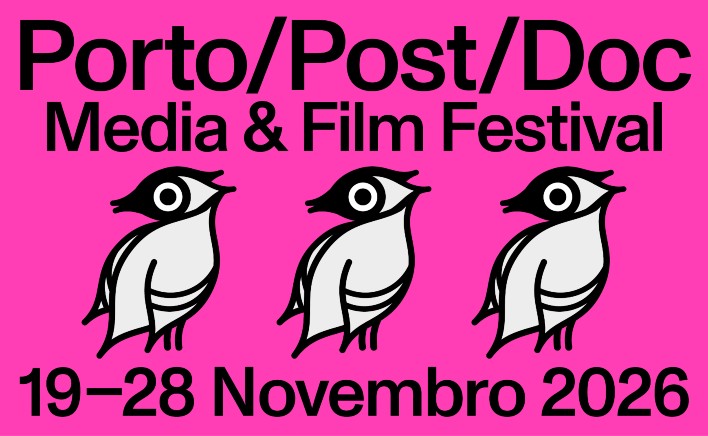
The 13th edition of Porto/Post/Doc: Film & Media Festival takes place from 19 to 28 November 2026 in Porto. Over ten days, it brings together filmmakers, audiences, programmers, critics, students, and film and media professionals around works that expand the boundaries of the cinema of the real and explore its relationships with fiction, the essay film, music, and the major political, social and human questions of our time.
Where Is the Cinema of the Real in 2026?
This edition renews the conviction that the cinema of the real offers some of the freest and most stimulating forms of filmmaking today. At a time marked by the fragmentation of community life and the individualism fuelled by algorithms, the festival champions cinema as a space for critical thinking, creative freedom and encounter. The programme brings together personal and collective portraits in which solidarity, resistance and joy endure, even under the most adverse conditions.
Across familiar places and distant geographies, this edition’s films reveal communities and individuals who refuse to succumb to injustice and exclusion. In their artistic and everyday gestures, we recognise a shared restlessness and the ability to portray human life with dignity. Their diverse forms and perspectives converge in the humanism that runs through the programme, making cinema a place of discovery and debate.
Thematic Programme: “In the Land of Others”
At the heart of the programme is “In the Land of Others”, the third and final chapter of the thematic trilogy that began in 2024 with “The Movement of Peoples”. Having reflected on human displacement and the journey as an existential, political and historical experience, the festival now turns to questions of belonging, identity and memory in unfamiliar territory.
The programme takes as its starting point the experience of living in, travelling through or imagining another’s country: a space of encounter and tension where histories of migration, exile, colonisation, diaspora, hospitality and exclusion intersect. Across different geographies, periods and cinematic forms, the films ask how we build a home away from home and how we live between languages, cultures and belongings.
Filmmaker Focuses and Special Programmes
This reflection extends to the focuses dedicated to Alain Gomis, a French filmmaker of Senegalese and Bissau-Guinean descent, and Finnish filmmaker Jan Ijäs. Through distinct careers and cinematic languages, both draw attention to what so often goes unnoticed: in Gomis’s work, everyday gestures, roots and the memories of those who live between places; in Ijäs’s, the waste of consumer society and the way we observe the pain of others from a distance.
The energy of resistance also runs through “The Future Is Punk”, which revisits films from a different historical context to consider the enduring power of rebellion, creativity and dissent. In “Another Story”, three films directed by women, made around fifty years ago, offer an opportunity to rediscover perspectives that remained on the margins of film history for far too long.
Porto on Film
The city takes centre stage through a partnership marking the 30th anniversary of the inscription of Porto’s Historic Centre on the World Heritage List. Through films made between 1931 and 2025, stories of places and people reveal the successive transformations of the city and the communities that inhabit it.
At its official opening screening, the festival presents the world premiere of “A Cidade e os Mapas”, directed by Alexandra Guimarães and Gonçalo L. Almeida and developed through the Working Class Heroes grant. In an age of gentrification, the film follows two of the city’s residents, tracing stories, memories and vestiges of the working class while connecting them to contemporary working and living conditions, from tourism to delivery platforms.
Competitions, New Audiences and Immersive Experiences
The competitive programme includes the International Feature Film Competition and the International Medium-Length and Short Film Competition, dedicated to works that challenge the boundaries between documentary, fiction, the essay film and hybrid forms. Cinema Falado highlights Portuguese-language filmmaking and Lusophone cultures; Cinema Novo introduces emerging Portuguese filmmakers; and Transmission explores the relationships between cinema, music, sound and contemporary culture. These programmes are complemented by the Human Rights in Motion Award, recognising films that address human rights and social justice, and the Youth Jury Award, presented by higher education students.
The festival continues to engage new audiences through the School Trip educational programme and Docs4Teens screenings for young viewers. At the Porto Planetarium, Immersive Dome Cinema presents audiovisual experiences in fulldome format, expanding the possibilities of artistic creation and our engagement with images and sound.
Porto Industry Days
Over four days, Porto Industry Days brings professionals together around project development, co-production and the circulation of films. In 2026, it strengthens its engagement with Europe through growing participation from different countries and collaborations with festivals, producers, and national and international institutions. The diversity of the programme and these encounters also benefits from the contribution of the international team of associate programmers.
Where is the cinema of the real in 2026? Porto/Post/Doc invites audiences to discover its many answers in cinemas, encounters and conversations that carry the films beyond the screen. From 19 to 28 November in Porto, cinema once again becomes a space for thought, resistance, joy and sharing.
